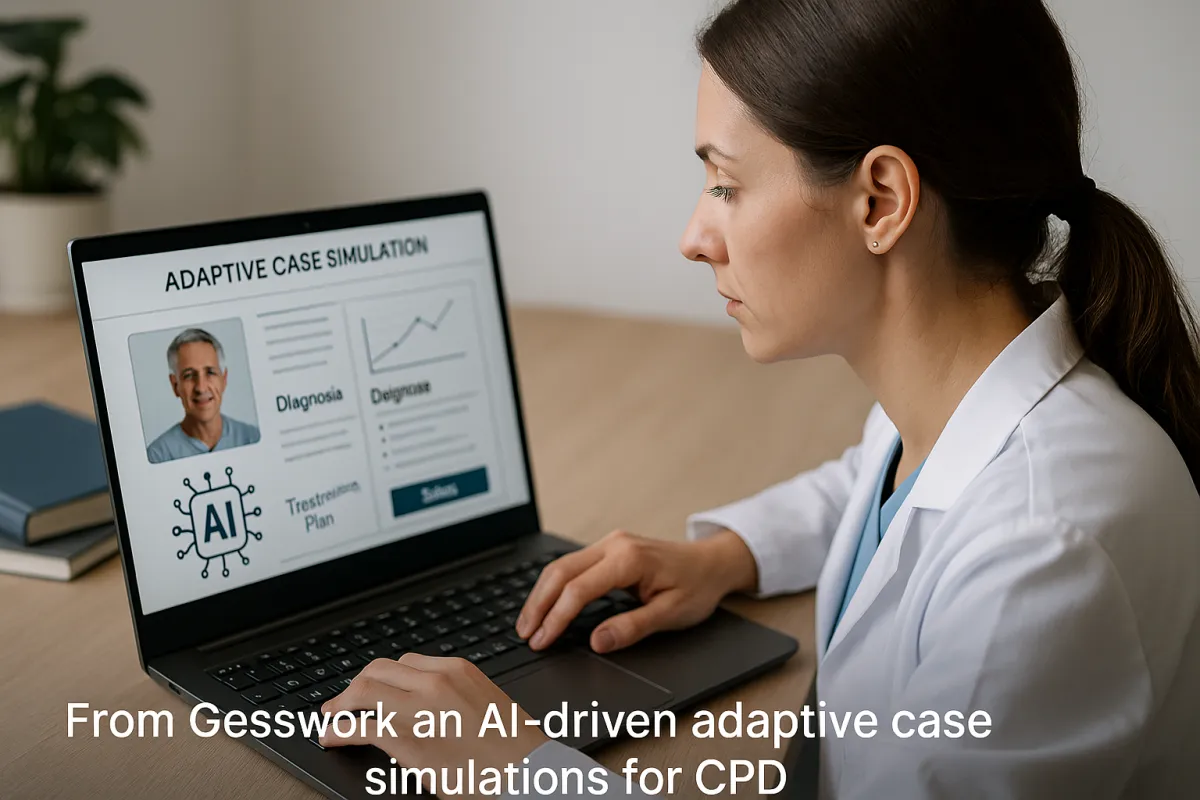
From Guesswork to Guidance: Adaptive AI Case Simulations in Clinical CPD
From Guesswork to Guidance: How AI is Transforming Clinical Case Simulations in Education
Introduction
In clinical education, static case studies often feel like rehearsed scripts—one-size-fits-all scenarios that offer limited engagement. But what if your CPD could mimic the unpredictable rhythms of real patient care—respond in real time, adapt to your decisions, and push you just beyond your comfort zone?
This is where adaptive AI case simulations are changing the landscape. They shift CPD from passive recall to active reasoning. And as organizational psychologist Adam Grant reminds us, true learning comes not from familiarity, but from embracing discomfort and deepening our reasoning.

The Power of Adaptive AI in Clinical Simulations
Adaptive AI systems personalise patient scenarios based on the learner’s choices. Each decision shifts the clinical narrative—correct interventions open one path, missteps create new challenges, and unexpected variables emerge, much like real practice.
This dynamic learning enables clinicians to:
Reinforce decision-making under uncertainty
Encounter rare or complex presentations safely
Practise without risk in a “fail without harm” environment
Adam Grant’s Insights: Why Discomfort Builds Competence
Adam Grant’s research gives context to why adaptive AI works so well:
Learning styles are a myth. Grant argues the method should fit the task, not just the learner’s preference.
Discomfort drives growth. He writes: “The best way to accelerate growth is to embrace, seek, and amplify discomfort.” Mistakes, struggle, and uncertainty are where deep learning happens.
Beware false familiarity. Grant cautions against mistaking recognition for mastery. Familiarity without challenge creates overconfidence.
👉 Adaptive AI cases mirror these principles: they deliberately stretch clinicians rather than reassure them.
What This Means for Clinical CPD
Better learning through safe failure. Realistic missteps sharpen diagnostic reasoning.
Task-driven education. Complex tasks benefit from branching AI feedback, not static slides.
Guarding against overconfidence. Adaptive scenarios prevent the illusion of competence by exposing gaps.
A Practical Layout for Adaptive Case CPD
Initial Scenario Setup → patient history + subtle red flags
Decision Node 1 → learner chooses assessment; outcomes branch
Feedback Checkpoint → compare actions to guidelines
Escalation Node → add comorbidity, patient preference, or contraindication
Final Debrief → highlight reasoning gaps, biases, and reflection points
Closing Thought
Adaptive AI case simulations are like a flight simulator for healthcare—safe, repeatable, and endlessly variable. They prepare practitioners not just to memorise guidelines but to think dynamically under pressure.
Ready to elevate your CPD? Subscribe to ManualCPD Insights and don’t miss Part 2: Beyond Dictation—AI Note-Taking That Teaches Back.
